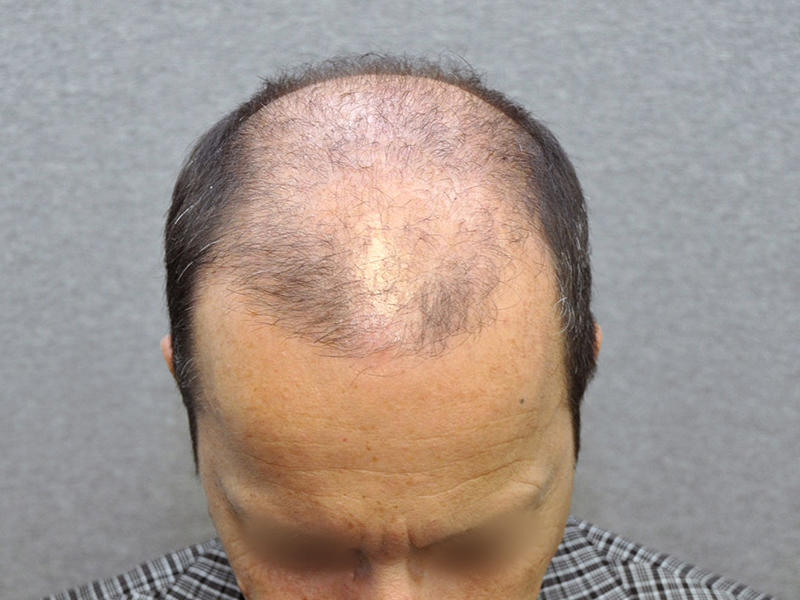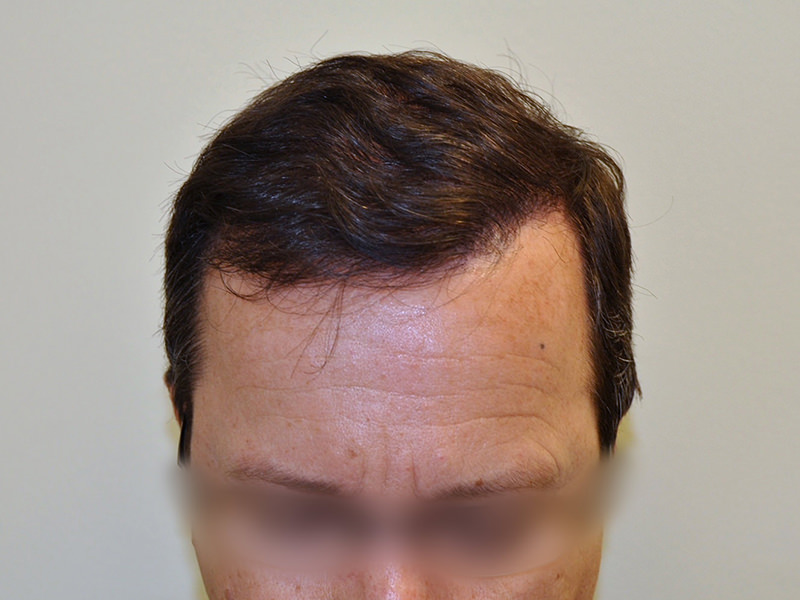


If you’re noticing more hair thinning, a receding hairline, or areas where your hair no longer grows as thickly as it once did, you may be wondering what treatments are available.
At Follicle HTFUE and FUT, we help patients from Mississauga explore surgical and non-surgical hair restoration options. Our surgeon-led practice offers FUE and FUT hair transplants, hairline lowering surgery, medication-based treatments, and injection therapies.
Meet with our surgeons at our Toronto or Thornhill clinics, or start with a virtual consultation to discuss your concerns and determine which treatments may be suitable.
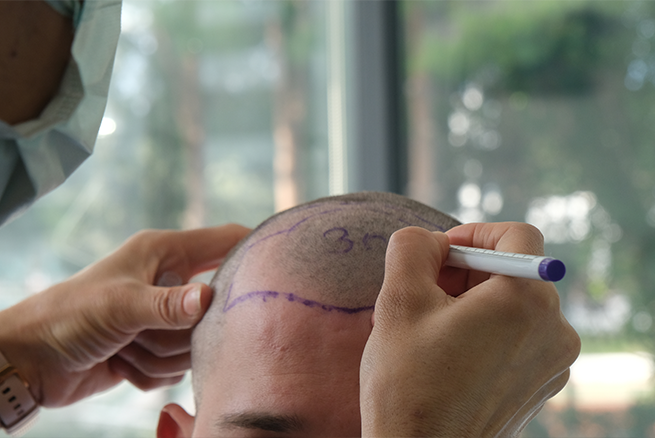
Hair Loss Treatment in Mississauga with Personalized Assessment
Hair loss looks different for everyone. Some people notice gradual thinning, while others have concerns about their hairline or facial hair. Before recommending treatment, our surgeons assess the cause and what can realistically be done to address it.
Pattern Hair Thinning
Male-pattern hair loss often begins with a receding hairline or thinning around the crown. Women may notice a widening part or a gradual reduction in hair density across the top of the scalp.
Our surgeons consider where the thinning has occurred, how it has progressed, and whether healthy donor hair is available for transplantation.
Sudden or widespread shedding may need further medical investigation before restoration is considered. For women whose thinning also affects the donor area, a transplant may not be suitable. Depending on the cause, medical treatment may help manage ongoing hair loss.
Changes in Hairline Shape
A naturally high forehead and a receding hairline can look similar, but they don’t necessarily require the same treatment.
If your hairline has moved backwards because of hair loss, transplantation may help restore coverage. If you’ve always had a high forehead, hairline lowering surgery could be another option.
We’ll consider your facial proportions, existing hairline, and desired appearance before discussing which approach makes sense.
Sparse Facial Hair
Some people have naturally sparse eyebrows, patchy beard growth, or limited moustache density. Hair transplantation may also help in selected areas affected by previous injuries or scarring.
We assess the condition of the skin, available donor hair, and how the surrounding hair grows. These details help determine whether transplantation is suitable and how the new hair should be placed.
Surgical Hair Transplant in Mississauga for Lasting Restoration
Hair transplantation moves healthy follicles from a donor area to parts of the scalp where more coverage is needed. It doesn’t create new hair follicles or prevent untreated hair from thinning further.
FUE and FUT, we offer FUE and FUT transplantation. We recommend a technique after considering your donor hair, desired coverage, and hairstyle preferences.
Individual Follicle Extraction
Follicular Unit Extraction (FUE) removes individual follicular units, usually from the back or sides of the scalp, and transplants them into areas affected by hair loss.
Your surgeon plans how the grafts will be positioned so the transplanted hair follows the natural direction of the surrounding hair.
FUE avoids the long, linear donor scar associated with FUT. However, it leaves small, round scars that may be visible depending on healing, the number of follicles removed, and hairstyle.
We also consider donor density and whether you’re comfortable trimming the donor area before recommending FUE hair transplantation.
Strip-Based Transplantation
Follicular Unit Transplantation (FUT) involves removing a narrow strip of hair-bearing scalp. The strip is then separated into individual follicular units for transplantation.
FUT leaves a linear scar, although surrounding hair may help conceal it. The technique can also allow patients to retain more of their existing hair length around the donor area.
It may be worth considering depending on how many grafts are needed, scalp flexibility, and your hairstyle preferences. Neither FUT nor FUE is automatically the better choice.
Surgical Hairline Lowering
If you have a naturally high forehead, you may be more interested in lowering your existing hairline than adding transplanted follicles.
Hairline lowering surgery brings the hair-bearing scalp forward and removes a portion of forehead skin. Unlike transplantation, it doesn’t rely on moving individual follicles from a donor area.
Your surgeon will assess scalp flexibility, hairline stability, facial proportions, and medical history. The procedure leaves an incision scar along the hairline, and how much lowering is possible varies from person to person.
Beyond Transplant Surgery: Non-Surgical Hair Treatment in Mississauga
Not everyone experiencing hair loss needs surgery. Medication and injection-based treatments may help with certain types of thinning, either on their own or alongside transplantation. The right approach depends on the cause of your hair loss and how it has progressed.
Medical Treatment Planning
If you’re experiencing ongoing thinning, medication may be an option worth exploring.
Minoxidil can help manage certain types of hair loss in men and women. Finasteride is another treatment commonly considered for suitable men with pattern hair loss.
Before discussing medication, we’ll review your hair-loss history, previous treatments, medical considerations, and what you’re hoping to achieve.
A clinician will also consider possible side effects, contraindications, and pregnancy-related risks when deciding whether a treatment is appropriate.
Unlike transplantation, medication doesn’t add follicles to thinning areas. Its purpose is to help manage hair loss or support existing hair.
PRP and PRF Therapies
Platelet-rich plasma (PRP) and platelet-rich fibrin (PRF) are injection-based treatments made from your own blood components.
The process involves collecting and processing a blood sample before using the prepared material in the selected treatment area. PRF differs from PRP because it contains a fibrin structure and is prepared differently.
These treatments may be considered alongside other approaches for certain hair-thinning concerns. However, the research supporting their use varies, particularly for PRF, and results aren’t guaranteed.
We can discuss whether injection-based hair-loss treatment may be appropriate and what options are currently available.
Ongoing Hair Care Guidance
Hair loss can continue to change after treatment, so it’s important to monitor how your hair responds.
If you’re using medication, review changes in shedding, hair coverage, or side effects with your clinician.
Patients who undergo transplantation receive postoperative instructions covering donor-area care, protection of transplanted follicles, and recovery precautions.
Your follow-up care depends on your treatment and how you respond.
Why Clients Choose Follicle HT as Their Hair Loss Clinic in Mississauga
For Mississauga residents comparing hair restoration providers, Follicle HT offers direct access to surgeons and several treatment options. Our physical clinics are in Toronto and Thornhill, where patients can meet with our team to discuss their concerns.
Direct Surgeon Involvement
Our surgical team includes Dr. Mark Korman and Dr. Philip Solomon. Their backgrounds include otolaryngology—head and neck surgery and facial plastic surgery.
Our surgeons actively participate in consultations, treatment planning, and surgical procedures.
This means you can speak directly with a surgeon about the treatment you’re considering, why it may be appropriate, and its limitations. You’ll also have the opportunity to ask questions before making a decision.
What Treatment Options Are Available for My Specific Needs?
The treatments we recommend depend on what you’re hoping to address.
If your hairline is receding or your scalp is thinning, we may discuss FUE, FUT, or medication to manage further loss.
A naturally high forehead may call for a different approach, such as hairline lowering surgery. For sparse eyebrows, beard hair, or moustache growth, transplantation may help add coverage in selected areas.
PRP and PRF may also be discussed for certain thinning concerns. Your surgeon will explain which options are worth considering for your situation.
What Does the Consultation Process Look Like?
You can request an appointment at our 305 Davenport Road clinic in Toronto or our 57 Centre Street clinic in Thornhill, Vaughan. We also offer virtual initial consultations.
During your appointment, your surgeon will ask about your hair-loss history, previous treatments, current concerns, and desired results.
You’ll learn which treatments may suit you, their limitations, and what to expect if you decide to proceed.
If you begin virtually, an in-person examination may be needed before treatment. Patients proceeding with surgery will also receive instructions for preparation and postoperative care.
Start Your Hair Restoration in Mississauga with Follicle HT
If you’re considering a hair transplant, want to manage thinning hair, or would like to change your hairline, our surgeons can help you explore your options.
We welcome patients from Mississauga for consultations at 305 Davenport Road in Toronto and 57 Centre Street in Thornhill, Vaughan. Virtual initial consultations are also available.
Find out whether FUE, FUT, hairline lowering, or a non-surgical treatment may be right for you.
Schedule a Consultation online or call (905) 764-7799 to get started.
START YOUR TRANSFORMATION TODAY
Your hair transplant journey begins with your decision to make a positive change.
At Follicle HT, our philosophy is that modern hair transplantation is a freedom granting procedure. We strive to help all our patients look and feel their very best by having the full range of options available.
Let’s open a discussion, see how we can help!